
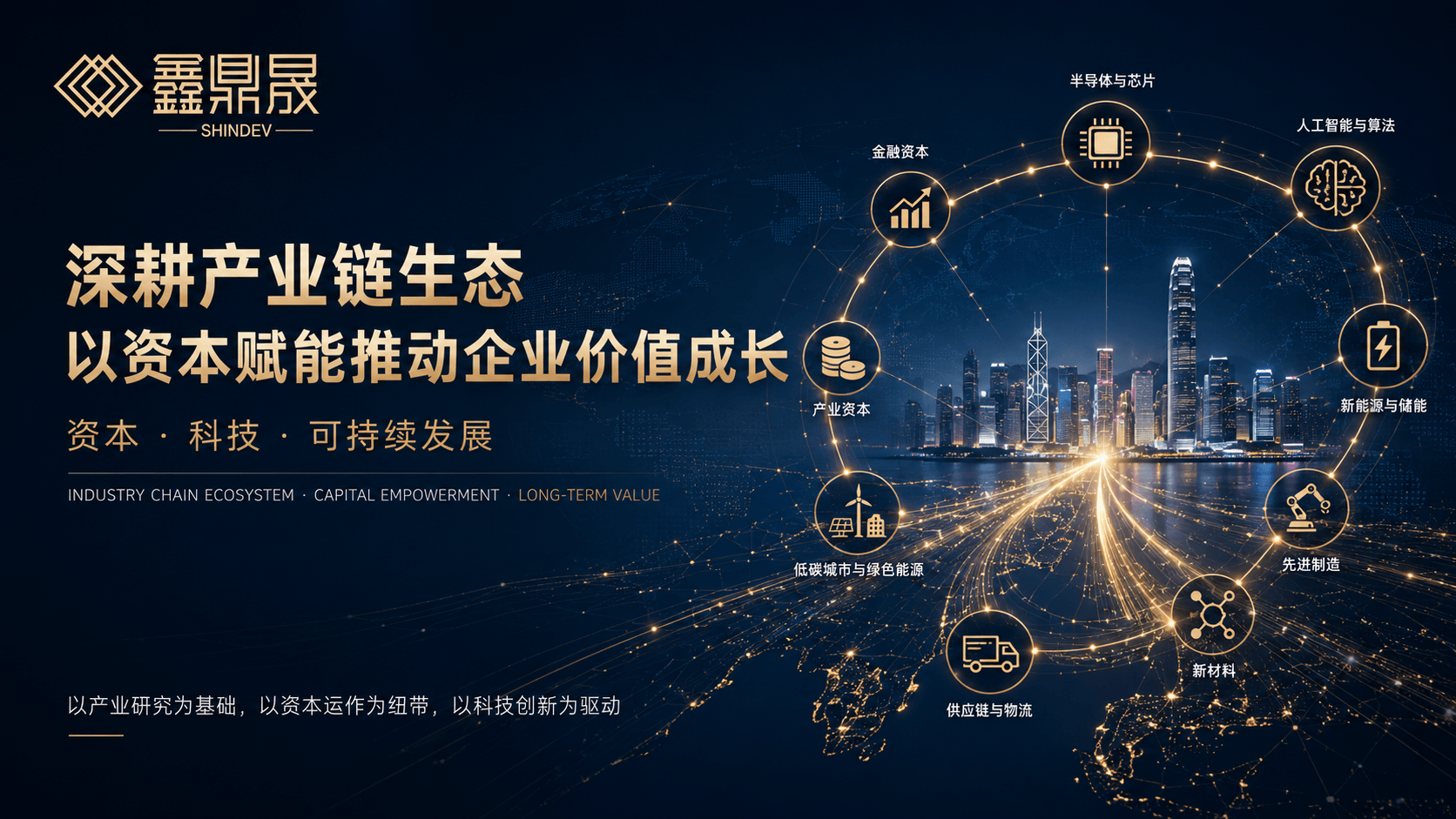
A company's development is never an isolated process.
Whether a company can grow depends not only on its team, products, technology, and market, but also on its position within the industry chain. What resources does it connect to? What scenarios does it serve? Can it collaborate with upstream and downstream partners? Can it find its place amidst industry changes? These factors often determine how far a company can ultimately go.
In the new industry cycle, capital cannot judge a company solely based on single-point performance.
In the past, the market tended to focus on a company's short-term growth rate, its financing capabilities, and the novelty of its business model. However, as industrial specialization becomes increasingly refined and resource synergy becomes more crucial, a company's true value often lies within its underlying industry chain relationships.
According to Xindingsheng, the industry chain is the soil for enterprise growth and a vital vehicle for economic development. The industry chain determines industry value, and industry value, in turn, determines a company's growth potential. Capital that only sees a company itself is prone to short-term opportunities; but if it understands the industry chain in which a company operates, it has a better chance of assessing its long-term value.
This is why Xindingsheng consistently emphasizes the industry chain perspective.
The significance of capital is not merely providing funding. More importantly, it involves identifying value through industry research, connecting resources through capital operations, improving efficiency through technological innovation, and helping companies develop more stable growth capabilities through long-term support.
Truly visionary capital not only discovers value but also participates in its growth; it not only invests in companies but also cultivates the entire industry chain ecosystem, creating long-term win-win situations through company growth, industry upgrading, and resource synergy.
A company's value, on the surface, comes from its products, technology, and operational capabilities; at a deeper level, it comes from its position in the industry chain.
Even with excellent products, a company will find it difficult to sustain its growth if it lacks stable supply, channel support, application scenarios, and upstream and downstream collaboration. Conversely, if a company is positioned within a chain with long-term demand, room for industry upgrading, and a foundation for resource synergy, even if it is small in its early stages, it may possess greater long-term growth potential.
This is the importance of the industry chain.
The industry chain is not simply an upstream and downstream relationship, but a system of resource flow and value transfer. R&D, manufacturing, supply, sales, service, finance, technology, and talent—each link can affect a company's development efficiency. A company's ability to reduce costs, improve delivery capabilities, and expand market share often depends on finding its suitable position within the value chain.
Some companies experience rapid short-term growth, but if they occupy an inefficient, low-barrier, and low-cooperation segment, their growth is likely to hit a bottleneck. Other companies, seemingly unassuming, possess key technologies, channels, or resources, making them irreplaceable in the value chain, and their long-term value is more noteworthy.
Therefore, judging a company requires not only looking at its current achievements but also at what it can connect, undertake, and amplify in the future.
Xindingsheng believes that a company's true growth potential is often not determined by a single advantage, but by its position within the value chain. Those who can create, link, amplify, and stabilize value within the value chain are more likely to build a competitive moat in the long run.
Capital entering an industry should not be limited to funding.
For many growth-oriented companies, funding is important, but it is not everything. In the course of development, enterprises often need clearer strategic judgment, more suitable industry resources, more stable partners, more precise market entry points, and long-term support that accompanies them through different stages.
The true value of capital lies in helping enterprises transform resources into capabilities, capabilities into growth, and growth into long-term value.
First, it's about discovering entrepreneurial value.
Many excellent companies in their early stages may not have a mature brand identity, nor may they be fully understood by the market. They may simply have solved a real industry pain point, mastered a solid technology, or been at a critical stage of upgrading. At this stage, capital doesn't need to chase trends, but rather to see the true growth logic behind the company through industry research.
Second, it's about creating connecting value.
Enterprise growth cannot rely solely on its own efforts. Often, the key to transforming a good project into a truly competitive company lies in whether resources can be connected. Capital can help companies connect with industry partners, upstream and downstream resources, market channels, technology partners, and application scenarios, enabling them to move from single-point breakthroughs to synergistic growth.
Third, it's about amplifying enterprise value.
When a company's capabilities align with the resources of the industrial chain, its value extends beyond its internal operations. Capital, through strategic planning, resource integration, brand building, and capital operations, can help companies enter larger market scenarios, allowing their technology, products, and services to be met by broader demand.
Fourth, it ensures stable long-term value.
Company growth is never smooth sailing. Market changes, cost fluctuations, intensified competition, policy adjustments, and management upgrades all affect a company's development pace. Long-term capital support not only helps companies grow faster but also helps them grow more steadily. Stable value means helping companies optimize governance, improve operational efficiency, enhance risk resistance, and maintain resilience during cyclical changes.
From this perspective, capital empowering the industrial chain is not simply about "investing money," but about facilitating smoother resource flow, enabling more solid company growth, and allowing the fuller release of industrial value.
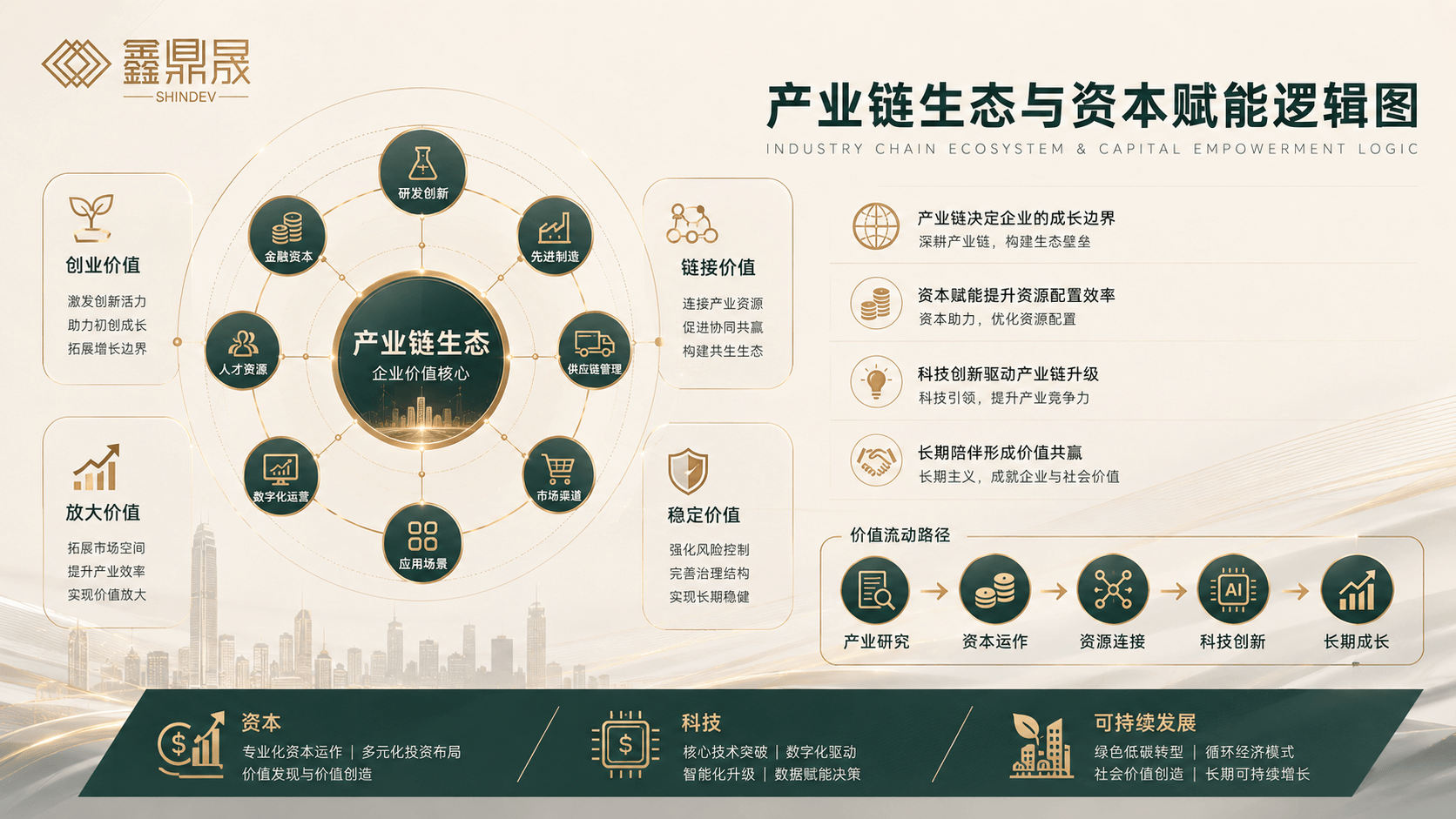
Focusing on the long-term value of the industrial chain, Xindingsheng continuously focuses on three directions: capital, technology, and sustainable development.
Capital is a tool for resource allocation and a link for industrial collaboration. Resources within the industrial chain do not flow naturally and efficiently. High-quality enterprises may lack suitable capital, technological capabilities may lack application scenarios, industrial resources may lack new growth outlets, and market demand may not find suitable recipients. The role of capital is to connect these scattered resources through professional judgment and systematic operation, allowing value to flow more efficiently within the industrial chain.
Technology is a crucial driving force for industrial upgrading.
Today's technological innovation is no longer just about breakthroughs in laboratories or updates to single products. It is permeating every aspect of manufacturing, energy, infrastructure, supply chains, service systems, and business operations, changing the organization and efficiency structure of the industrial chain. Xindingsheng Company focuses on technology not to chase concepts, but to ensure that technology can truly enter industry, solve practical problems, and help enterprises improve efficiency, reduce costs, and enhance competitiveness.
Sustainable development is a crucial direction for long-term value.
A company's development cannot only focus on short-term scale; it must also consider resource efficiency, operational resilience, environmental adaptability, and long-term responsibility. Future industrial competition will not only be a competition of growth rate but also a competition of efficiency, quality, and sustainability. Companies that can balance commercial value and long-term responsibility during their development are more likely to weather economic cycles.
Based on these three directions, Xindingsheng has formed a relatively clear strategic path: grounded in industry research, linked by capital operations, and driven by technological innovation, continuously cultivating the industry chain ecosystem within a long-term framework of sustainable development.
Good capital judgment is inseparable from industry research.
Looking only at financial data easily reveals the results but not the reasons; looking only at market hype easily reveals sentiment but not value. Why can a company grow? Can its growth be sustained? Are its barriers to entry genuine? Are its resources stable? Ultimately, the answers lie within the industry chain.
Industry research answers a set of more fundamental questions:
Does this industry have long-term demand?
Where does this company occupy in the industry chain?
Is the problem it solves real enough?
Is its capability continuously needed by upstream and downstream companies?
Can it be replicated and extended on a larger scale?
These questions determine whether a company is worth long-term attention.
Xindingsheng emphasizes industry research, not just for finding investment targets, but more importantly, for understanding the logic behind corporate value growth. Only by understanding the industry chain can one understand a company's growth path; only by understanding upstream and downstream relationships can one judge a company's future potential; only by clearly understanding the connections between technology, market, resources, and policy can one find companies truly worth long-term investment.
The development of the industry chain essentially depends on the flow of resources.
However, in reality, resources are often scattered. Companies may have technology but lack markets; they may have orders but lack production capacity; they may have products but lack distribution channels; they may have potential but lack long-term capital support. Many opportunities in the industry chain do exist, but they haven't been effectively connected.
The value of capital operation lies in connecting these links.
Xindingsheng hopes to better organize companies, capital, technology, industry resources, and market demand through capital operation. For businesses, this connection helps them acquire the resources needed for development; for industries, it improves overall collaborative efficiency; and for capital, it allows value to move from single-point investment to long-term win-win outcomes.
Good capital doesn't evaluate companies from outside the industry; instead, it enters the value chain to understand, support, and connect with them.
Technological innovation ultimately translates into industrial efficiency.
A technology that cannot be applied to real-world scenarios, improve cost structures, increase production efficiency, or enhance service capabilities will struggle to generate long-term value. Conversely, when technological innovation is closely integrated with the needs of the value chain, it brings not only growth to individual companies but also potentially improved efficiency across the entire chain.
This is also the focus of Xindingsheng's attention to technological innovation.
In the value chain, the value of technology is not merely conceptual but manifested in higher efficiency, better products, lower costs, stronger delivery capabilities, and more stable services. Capital's role is to help truly valuable technological innovations find suitable application scenarios, facilitate the market entry of technological capabilities, and help companies transform innovation into sustainable growth.
Technology makes supply chains more efficient, and capital allows technology to better penetrate industries.
Future capital competition will not only be about who can find projects, but also about who can understand the industry, organize resources, support companies, and co-build the ecosystem.
The growth of individual companies is inseparable from the supply chain; the upgrading of the supply chain is also inseparable from the breakthroughs of individual companies. If capital only focuses on single-point returns, it is easy to miss the long-term value brought about by the overall upgrading of the supply chain. Only by understanding companies within the supply chain and allocating resources within the ecosystem can capital truly drive value growth.
Xindingsheng Capital believes that building a supply chain ecosystem requires long-term patience and systematic capabilities. It cannot be completed with a single investment, cooperation, or project, but is gradually formed through continuous research, continuous connection, and continuous empowerment.
In this process, capital should not only select companies, but also help them find better industry positions; not only provide funds, but also help resources achieve higher efficiency; not only share the growth results, but also participate in the value growth process.
The supply chain determines the space for corporate value growth, and capital determines the efficiency of resource allocation. In this new stage of development, truly visionary capital will not merely be content with discovering value, but will further drive value growth; it will not only focus on the short-term performance of a single company, but will pay attention to the underlying industrial chain ecosystem; it will not only pursue short-term returns, but will grow together with companies and industries through long-term partnerships.
In the future, Xindingsheng will continue to focus on three major directions: capital, technology, and sustainable development. Based on industry research, using capital operation as a link, and driven by technological innovation, it will continuously cultivate the industrial chain ecosystem, focusing on companies and industry nodes that truly possess entrepreneurial, connecting, amplifying, and stabilizing value.
Xindingsheng hopes to help high-quality companies unleash greater growth potential within the industrial chain through deeper industry understanding, more efficient resource connections, and longer-term capital support, thus helping capital and industry form a more stable, sustainable, and win-win development relationship.
True value is not defined by short-term hype.
It grows within the industrial chain and requires continuous nurturing from capital over time.